The International Red Cross : A WWII Messenger
From 1939 to 1945, the Second World War devastated families across the globe. As prejudice against Jewish folk grew within Germany, in years leading up to the war, many managed to leave the country. Once war broke out, however, their family members left in Germany were trapped with no way of contact. Post was not permitted to be sent to or received from territories fighting against Germany in the war, most notably the United States and Great Britain. There was one option, however: The International Red Cross. They were responsible for delivering about 24 million messages throughout the duration of World War II, many of which went in and out of Germany, and to and from Jewish family members. After following a list of tedious instructions, Jewish individuals were able to write and send updates regarding their wellbeing to family members nations away. Telegrams sent in and out of Germany through the International Red Cross were one of the most important connections between separated Jewish families. Though their writing restrictions were plentiful, sending these messages was necessary for emigrated families as they provided hope and kept them from truly being isolated from one another, despite Nazi Germany’s efforts in alienating its people.
In 1936, messaging services operated by the International Red Cross were established. During the war, the Red Cross most notably, under Article 79 of the 1929 Geneva Convention, was permitted to deliver telegrams to and from prisoners of war (Treaties, States parties, and Commentaries – Geneva Convention, ART. 79). Additionally, they were allowed to deliver food packages sent by their families (A. Breitbart, Wiesenthal Center Senior Researcher, personal communication, October 2, 2022). A large number of their messages, however, were between Jewish families living in opposing territories. Through this system, Jewish emigrants were enabled to stay in contact with their families still in Germany. In a letter from Tadek Becker addressed to his mother, Zelda Brecker, on January 18, 1940, he says, “Write to [Father, Lolek, and I] about all of that via the Red Cross (this is the simplest way),” (JFCS Holocaust Center, page 5). At this time, Tadek was stuck in Berlin while his mother and brother, Martin Becker, were living in the United States. His family living in allied territory, German enemy territory, meant he was not allowed to send post to them. Yet, the situation was not hopeless. He states “the simplest way” of contact is through the Red Cross. They are the most accessible option.
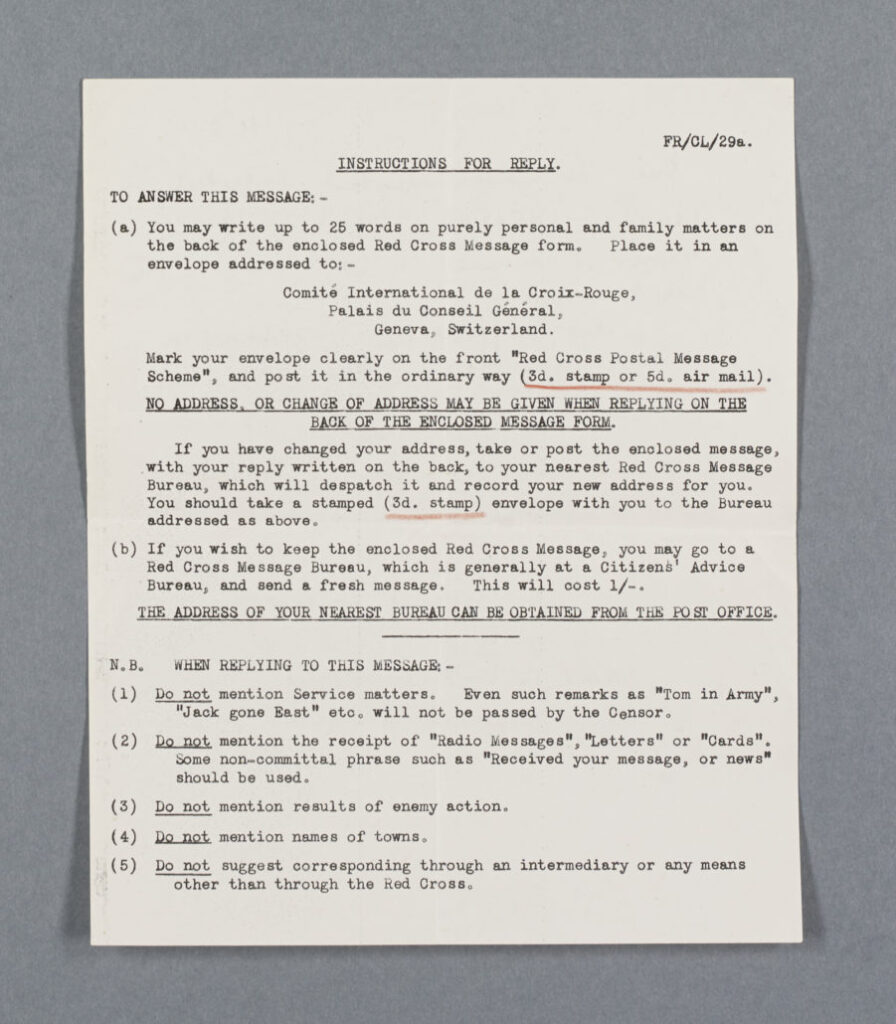
In no way were these Red Cross messages extensive letters. These were brief telegrams whose mainly served purpose was letting family members know the sender was alive. In a Red Cross “Instructions for Reply” document preserved by the German Jewish Family Archives, it’s stated that the message is not to exceed 25 words, in order to make the censoring more efficient (Red Cross Letter: Instructions for Reply). Additionally, delivery of a single telegram would take months upon months. The replier is to discuss family related subject matter only. They are not to mention any news relating to the war, the receiving of messages (letters, radio, cards, etc.), any town names, enemy actions, or suggestions of contact through systems other than the Red Cross. Any text that falls under these categories would be censored. To avoid censorship, individuals attempted writing in code. For example, ‘deported’ would be written as ‘emigrated,’ such as in a Red Cross message anonymously sent to Marianne Simion(a Jewish woman living in London at the time), regarding her mother. It reads, “Unfortunately, your beloved mother emigrated to Theresienstadt in late June,” (Red Cross Letters: Proof of Life in 25 Words or Less). Censorship is an obstacle in and of itself. The word limit, however, adds another thick layer. A telegram from Eric Federmann, who was living in New York City at the time, to his brother Paul in Berlin reads, “Hope you are well, no news of you in long time. Alice and I are well, working. Gerds and all relatives send greetings. Love. / Erich,” (Letter from Eric Federmann to Paul). This was the entire message. It would take months upon months for this telegram to reach Paul, only for him to read less than 25 words. Still, these less than 25 words were more than nothing.
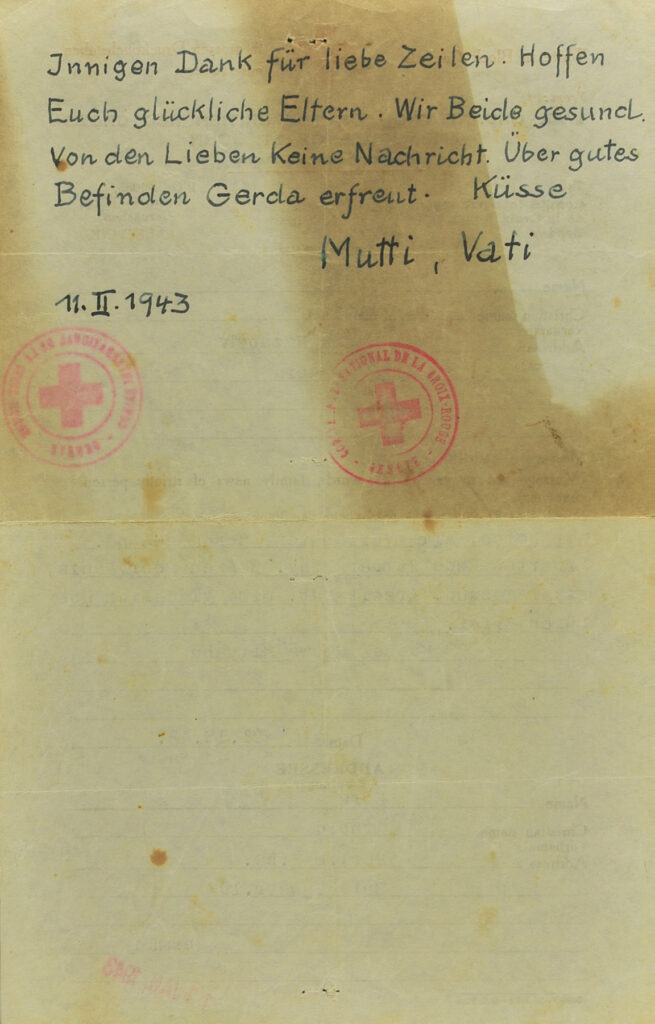
The apparent frustrations that come about from these restricting requirements can be observed. Yet they still serve their purpose in updating individuals on their family’s well being. They still provide connections that would have been alternatively cut off. The Eric Federmann telegram tells his brother, Paul, everything he needs to know. It tells him that he and his wife are well enough to write and it tells him they have money, courtesy of the “Alice and I are well, working.” In 1943, Erna and Arnold Korn(a married couple) wrote in a telegram to their son Walter-Eliyahu, “Sincere thanks for your words. Hope you are happy parents. We are both fine. No news of our dearest ones. [Happy that Gerda is well]. Kisses. / Mother, Father,” (Last Letters from the Holocaust: 1943). Again, this is the entire message. One can infer that these parents, who have not been able to see their son for years, who know very well that this may be the last he hears of them, wish so very much to say a thousand words. But alas, they’re not allowed. Though it’s heartbreaking, again, what’s the alternative? Nothing. Since before the start of the war, Walter-Eliyahu had been living in Israel while his parents were stuck in Berlin. For the years leading up to the war, Walter-Eliyahu and his parents sent letters back and forth weekly. However, once the outbreak of the war hit, Walter stopped regularly receiving posts. Instead, he began receiving telegrams delivered through the International Red Cross. Letters addressed to enemy territory were not allowed out of Germany, Israel and New York City included. Without these restricted messages, they would not have been able to keep contact. The Korn and Becker families’ options were 25 words or nothing.
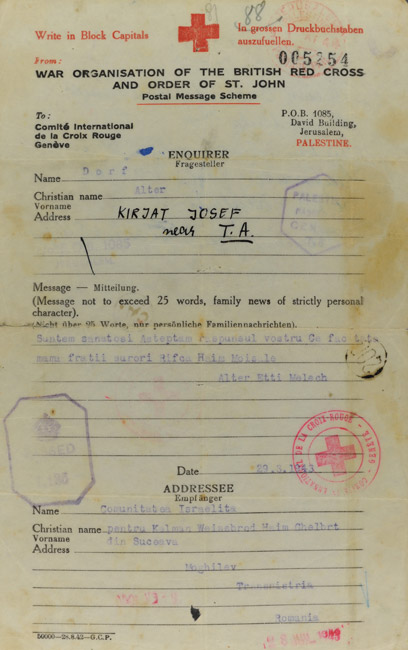
On top of connection, these telegrams provided sources of hope, especially for those taken to Nazi concentration camps. The Ghelbert family, up until the war, lived in a Northern Romanian village. They unfortunately, in 1941, were deported and forced to the Katsmazov concentration camp. After nearly two full years, they received a Red Cross telegram from an extended family member living in Israel. A Yad Vashem page, in regards to this message, states, “The telegram was a source of great happiness among the inmates in the camp since this was their first and almost only connection with the outside world; it signified that their existence was known to people in the free world,” (“We are Healthy in the Katsmazov Ghetto”). The Ghelbert family addressed telegram reads, “We are healthy. Awaiting your reply. How are father, mother, our brother, our sister, Rifca, Haim, Moisale? / Alter, Etti, Melech,” (“We are Healthy in the Katsmazov Ghetto”). These words, though simple and brief, sparked hope among the camp prisoners. Logically speaking, that message is meaningless. To them, however, it meant everything.
It is saddening how little words could be sent, even more so considering the gaping period of time these families had to wait for each message. Yet, what’s most saddening is the Nazi jurisdiction of complete cutoff from loved ones living in outside territories. This Red Cross connection, despite the heavy restrictions, was necessary for these Jewish families and individuals. It is thanks to these messages that Jewish families within German territory could keep contact with their emigrated family members. It is thanks to these messages that camp prisoners could feel even the littlest amount of joy.
References
Treaties, States parties, and Commentaries. Geneva Convention on Prisoners of War, 1929. https://ihl-databases.icrc.org/ihl/INTRO/305
Treaties, States parties, and Commentaries. Geneva Convention on Prisoners of War, 1929 – PART VI : BUREAUX OF RELIEF AND INFORMATION CONCERNING PRISONERS OF WAR – ART. 79. https://ihldatabases.icrc.org/applic/ihl/ihl.nsf/Article.xspaction=openDocument&documentId=A1DAA9CE7432A838C12563CD00519260
(2017) History.com. Geneva Convention. https://www.history.com/topics/world-war-ii/geneva-convention#section_3
Letters: 1938-1946. JFCS Holocaust Center of SF. https://holocaustcenter.jfcs.org/library-archives/exhibits/letters-1938-1946/
Last Letters from the Holocaust: 1941. Yad Vashem. https://www.yadvashem.org/yv/en/exhibitions/last-letters/1941/index.asp#/overview
Last Letters from the Holocaust: 1943. Yad Vashem. https://www.yadvashem.org/yv/en/exhibitions/last-letters/1943/korn.asp
Yad Vashem Documents Archive. Yad Vashem Documents Archive. https://documents.yadvashem.org/index.html?language=en&search=advance&re_value=O.75&re_type=literal&mt_value=Red%20Cross%20letter&mt_type=exact
(2015). The Red Cross and World War Two. History Learning Site. https://www.historylearningsite.co.uk/world-war-two/the-red-cross-and-world-war-two/#:~:text=These%20’letters’%20were%20restricted%20to,million%20messages%20had%20been%20exchanged.
JFCS Holocaust Center – Northern California’s Primary Resource. JFCS Holocaust Center of SF. https://holocaustcenter.jfcs.org/app/uploads/2015/06/letters-catalogue.pdf
Red Cross Letters: Proof of Life in 25 Words or Less. Jewish Museum Berlin. https://www.jmberlin.de/en/red-cross-letters-proof-life-25-words-or-less
Letters Home. HI Stories. https://histories.hoover.org/letters-home/
Red Cross Letter. German Jewish Family Archives. http://www.sussex.ac.uk/affiliates/gjfa/collections/1939-1945-world-war-ii/red-cross-letter/
Red Cross Letter: Instructions for Reply. German Jewish Family Archives. http://www.sussex.ac.uk/affiliates/gjfa/red-cross-letter-instructions-for-reply/
Letter from Eric Federmann to Paul (1944). German Jewish Family Archives. http://www.sussex.ac.uk/affiliates/gjfa/red-cross-letter-from-eric-to-paul/
Notes on Communicating with Occupied Territory. German Jewish Family Archives. http://www.sussex.ac.uk/affiliates/gjfa/notes-on-communicating-with-occupied-territory/
“We are Healthy in the Katsmazov Ghetto.” Yad Vashem. The World Holocaust Remembrance Center. https://www.yadvashem.org/gathering-fragments/stories/correspondence/ghetto-katzmazov.html
