- Cinque Parole
- Mi piacciono le parole “rinascimentale,” “la chiesa” e “la panetteria.” Mi piacciono i frasi “di dove sei?” e “oggi non nevica.” “Rinascimentale” e “la chiesa” sono molto eleganti. “La panetteria” è divertimento dire. Mi piace dire doppia t. “Di dove sei?” e “Oggi non nevica” sono divertimento dire.
- Bruschetta all’aceto balsamico
- Voglio molto mangiare questa ricetta. Mi piacciono molto pomodori e pani. Fare la ricetta è veloce e semplice. Non so fare la ricetta, che triste.
- # fuori c’è il sole (Lorenzo Fragola)
- Questa canzone è molte bella. È vivace, affascinante e tranquillo.
- Il Diario
- Questi giorni, faccio molti compiti. Devo fare i compiti per il corsi di scienze della comunicazione, di teatro e di italiano. Mi piace studiare l’Italiano, è molto divertimento e interessante. Il venerdì, mi piace cenare con i miei amici. Miei amici e mi piace mangiare la pizza.
All posts by Hannah
Weekly Writing #9
Letters to a Young Writer
I really enjoyed this past week’s reading of Letters to a Young Writer and the activity done along with it. The division of labor and sharing main takeaways in class felt like a very effective way of collaborative learning. As well, I found the letters I personally read to be very helpful. Before high school, I was very passionate about creative writing but fell out of it in order to focus on other things. I’ve started wanting to get back into creative writing this year, however, and doing this reading even more so re-sparked my love for writing. The reading provided me inspiration and motivation to write more. I was also able to take a lot of advice from the chapters everyone else read. By going down the list of chapters in class and having each assigned person share main points I was able to absorb all the important information. Additionally, I learned how to better effectively summarize and analyze texts through taking overall main points and themes. Though, the reading felt more geared towards creative and professional writing. I wonder how one could apply this advice for writing for school such as in analysis or persuasive writing.
Weekly Writing #8
Historical Letters: Think, Pair, Sharing
In this class alone, we’ve done several collaborative activities that involve reflecting, questioning, and analyzing with other students. For this week’s assignment, we had to read two selected historically famous letters and think, pair, share with our partner for each then share with the class. What differentiated this activity, for me, was feeling very supported by my partner. When presenting, it was very easy to bounce off the other and speak together. This was really nice for me because I normally get very nervous volunteering to speak in class, but it felt more possible with my partner. Reflecting with a partner also allowed for me to realize things I didn’t notice before or help me understand the letters better. I do wonder, however, in these activities, whether we should be focusing more on analysis or our thoughts based on reading? I didn’t feel I had as many significant things to say compared to other students. It felt as though they had more closely read the letters than I believed we were meant to.
Creative Writing Using the Epistolary Format
There Was Nothing There
My therapist says writing before bed is the best way to wind down in order to direct my restless brain, to mitigate my racing thoughts. It gets a little tedious sometimes, though.
“Dear Midnight, Things feel like a lot sometimes. Actually, maybe all the time. But sometimes it’s okay. Like, it’s a manageable ‘a lot,’ you know?”
Most of the time there’s an endless amount of thinking happening in my head, so then I write too much and my hand starts to cramp. The skin around my nails goes numb and turns a sickly pink.
“I had to do a presentation for class today. I really did know my topic. I was so sure I didn’t need notecards. But I couldn’t stop focusing on the 23 pairs of eyes seeing my unwashed hair, noticing every fidget and shiver. I couldn’t help but obsess over the minds realizing that I had worn the same pair of pants last class, too. I could feel their ears twitch with every stutter I spoke.”
There’s a faint tapping sound coming from the corner of my ceiling. Maybe it’s mice. It’s quiet, should be easy to ignore. Still, it’s piercing the inside of my head. Ignore it. Just write. Keep writing.
“Today, I ate a granola bar, a cup of ramen, and two bags of Lays potato chips. I didn’t finish the cup of ramen. I thought it’d be a good idea to try new things and eat the spicier kind this time. It was not a good idea.”
Tap, tap.
“These days I’m not craving food as much. Before, at night especially, I’d eat everything I could. But then I’d think about the alphabet soup I’ve made in my stomach then throw it all up. Then the next night again: eat, eat, eat, barf.”
No stopping.
“That routine got to be too gross. Now I try to limit myself to a granola bar everyday. But some days I break that rule, like today. This way, though, there’s less mess.
The tapping stopped. Maybe it wasn’t actually there at all.
“I had to walk back home alone today. There was a meeting so it was closer to dark by the time I headed out.”
Scratch, scratch.
“While walking, I could feel these eyes burning through me.”
Tap.
“I was so sure there was someone or something watching, following.”
Tap.
“Without turning back, my ears listened for extra footsteps. My eyes watched for shadows that weren’t my own.”
The tapping definitely had not stopped.
“I held my keys tight.”
Scratch… Tap.
“My feet sped up their pace.”
Tap, tap.
“Were they following faster now?”
Tap, tap, tap.
They’re coming from the window now.
“If I ran, would they still follow?”
Or is it still the ceiling?
“Quicker.”
If I ran, would it all go away? If I hid, would it all stop?
“The wind got louder, the air got colder.”
Tap, tap, tap. Scratch, scratch, scratch.
“I couldn’t look behind me. I was afraid of what might be there, that I might’ve been right all along.”
It’s just your imagination, just ignore it.
“What if it’s not my imagination?”
Bang. It’s the door now. Or maybe the window again?
“Is it safe to run home?”
Bang. Scratch. Bang, bang, bang.
“I can’t.”
BANG.
“I can’t” ignore it.
I can’t.
“I can’t.”
I CAN’T.
“I CAN’T” STOP.
STOP.
“DON’T STOP” TAPPING… TAP… TAP… Tap… Tap.….. “I stopped.” I checked. There was nothing there. “There was nothing there…”
Nothing.
“Nothing…”
…
I guess I can go to sleep now.
Weekly Writing #7
Forged Letters: Reflecting on Can You Ever Forgive Me?
The story of Lee Israel through her memoir, Can You Ever Forgive Me?, stands as both a thought provoking and strangely genuine one. Over and over again, mistake after mistake, we are continually told how unlikable a person Lee Israel is. Her agent even goes as far to say her attitude is what’s costing her career as a writer. Though lying and insulting are definitely unlikable habits, one may question why didn’t she change herself to be more “likable?” It’s quite admirable. In an industry that requires approval from others, she never changed who she was. Contrasting the story’s theme of dishonesty, she always stayed true to herself. Her personal growth, as well, stands to be quite admirable. In her final testimony before being given sentence she states, “I mean, it’s the only time, recently, that I can remember being proud of my work. But it wasn’t really my work, was it? I mean, if I had put in my work, then I would’ve been opening myself up to criticism, and I’m too much of a coward to do that.” Since the start of her career, she had written about other people, never herself. Yet, her deciding to write a memoir shows her newfound ability to finally embrace herself. Lee Israel’s story is not an inspiring one, but an admirable one.
Weekly Writing #6
Epistolary Fiction
In preparation for our upcoming creative writing assignment, this week’s focus was on fiction written in the epistolary format. Whether written through diaries or correspondence, the epistolary format can provide a more personal level of character development, experience, personality, and more. Readers may feel a strong connection to said characters when reading these kinds of pieces of fiction. Additionally, epistolary fiction can more clearly show relationships or dynamics between different characters. Through this week’s focus, I learned just how many different ways a story can be written using the epistolary format. When reading Counting the Days, where rather than the whole story being told through letters, quotes are dispersed in order to support the story rather than be its entirety, I realized there is no one true way to write these kinds of stories. This week has made me feel much more prepared for our creative writing assignment. I feel as though I’ve been given many different pieces of inspiration.
World War II Letter Writing Essay
The International Red Cross : A WWII Messenger
From 1939 to 1945, the Second World War devastated families across the globe. As prejudice against Jewish folk grew within Germany, in years leading up to the war, many managed to leave the country. Once war broke out, however, their family members left in Germany were trapped with no way of contact. Post was not permitted to be sent to or received from territories fighting against Germany in the war, most notably the United States and Great Britain. There was one option, however: The International Red Cross. They were responsible for delivering about 24 million messages throughout the duration of World War II, many of which went in and out of Germany, and to and from Jewish family members. After following a list of tedious instructions, Jewish individuals were able to write and send updates regarding their wellbeing to family members nations away. Telegrams sent in and out of Germany through the International Red Cross were one of the most important connections between separated Jewish families. Though their writing restrictions were plentiful, sending these messages was necessary for emigrated families as they provided hope and kept them from truly being isolated from one another, despite Nazi Germany’s efforts in alienating its people.
In 1936, messaging services operated by the International Red Cross were established. During the war, the Red Cross most notably, under Article 79 of the 1929 Geneva Convention, was permitted to deliver telegrams to and from prisoners of war (Treaties, States parties, and Commentaries – Geneva Convention, ART. 79). Additionally, they were allowed to deliver food packages sent by their families (A. Breitbart, Wiesenthal Center Senior Researcher, personal communication, October 2, 2022). A large number of their messages, however, were between Jewish families living in opposing territories. Through this system, Jewish emigrants were enabled to stay in contact with their families still in Germany. In a letter from Tadek Becker addressed to his mother, Zelda Brecker, on January 18, 1940, he says, “Write to [Father, Lolek, and I] about all of that via the Red Cross (this is the simplest way),” (JFCS Holocaust Center, page 5). At this time, Tadek was stuck in Berlin while his mother and brother, Martin Becker, were living in the United States. His family living in allied territory, German enemy territory, meant he was not allowed to send post to them. Yet, the situation was not hopeless. He states “the simplest way” of contact is through the Red Cross. They are the most accessible option.
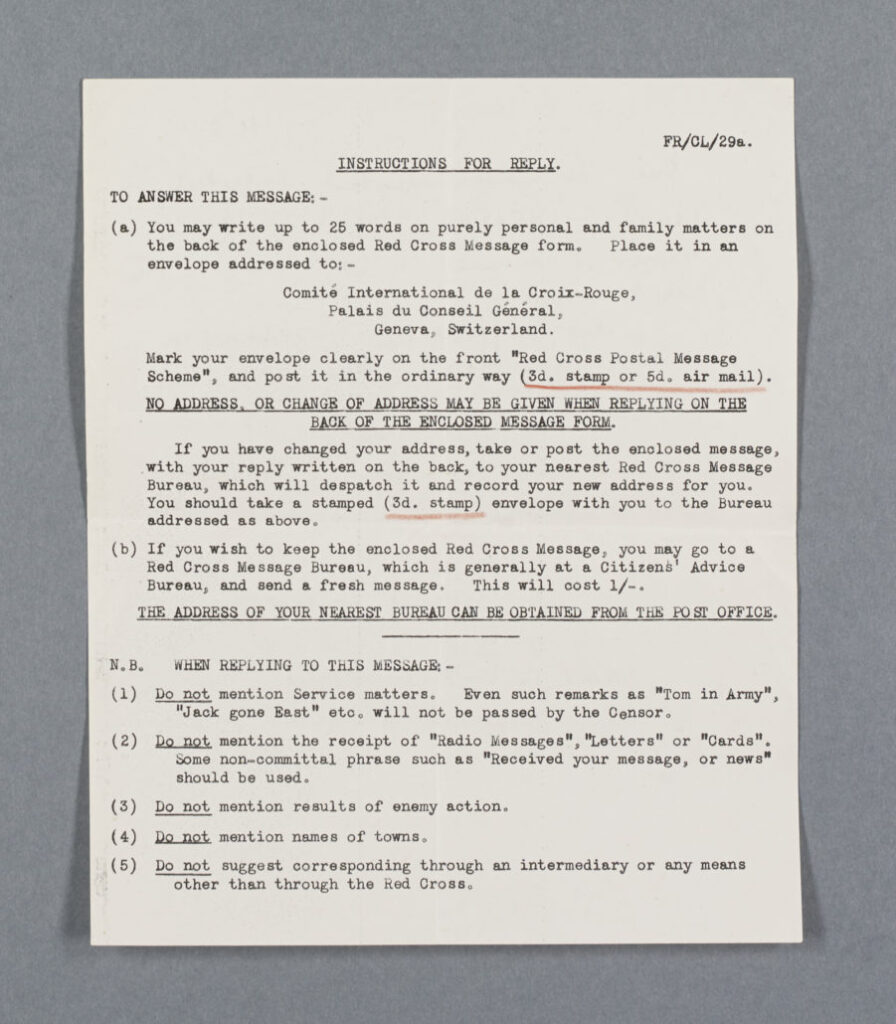
In no way were these Red Cross messages extensive letters. These were brief telegrams whose mainly served purpose was letting family members know the sender was alive. In a Red Cross “Instructions for Reply” document preserved by the German Jewish Family Archives, it’s stated that the message is not to exceed 25 words, in order to make the censoring more efficient (Red Cross Letter: Instructions for Reply). Additionally, delivery of a single telegram would take months upon months. The replier is to discuss family related subject matter only. They are not to mention any news relating to the war, the receiving of messages (letters, radio, cards, etc.), any town names, enemy actions, or suggestions of contact through systems other than the Red Cross. Any text that falls under these categories would be censored. To avoid censorship, individuals attempted writing in code. For example, ‘deported’ would be written as ‘emigrated,’ such as in a Red Cross message anonymously sent to Marianne Simion(a Jewish woman living in London at the time), regarding her mother. It reads, “Unfortunately, your beloved mother emigrated to Theresienstadt in late June,” (Red Cross Letters: Proof of Life in 25 Words or Less). Censorship is an obstacle in and of itself. The word limit, however, adds another thick layer. A telegram from Eric Federmann, who was living in New York City at the time, to his brother Paul in Berlin reads, “Hope you are well, no news of you in long time. Alice and I are well, working. Gerds and all relatives send greetings. Love. / Erich,” (Letter from Eric Federmann to Paul). This was the entire message. It would take months upon months for this telegram to reach Paul, only for him to read less than 25 words. Still, these less than 25 words were more than nothing.
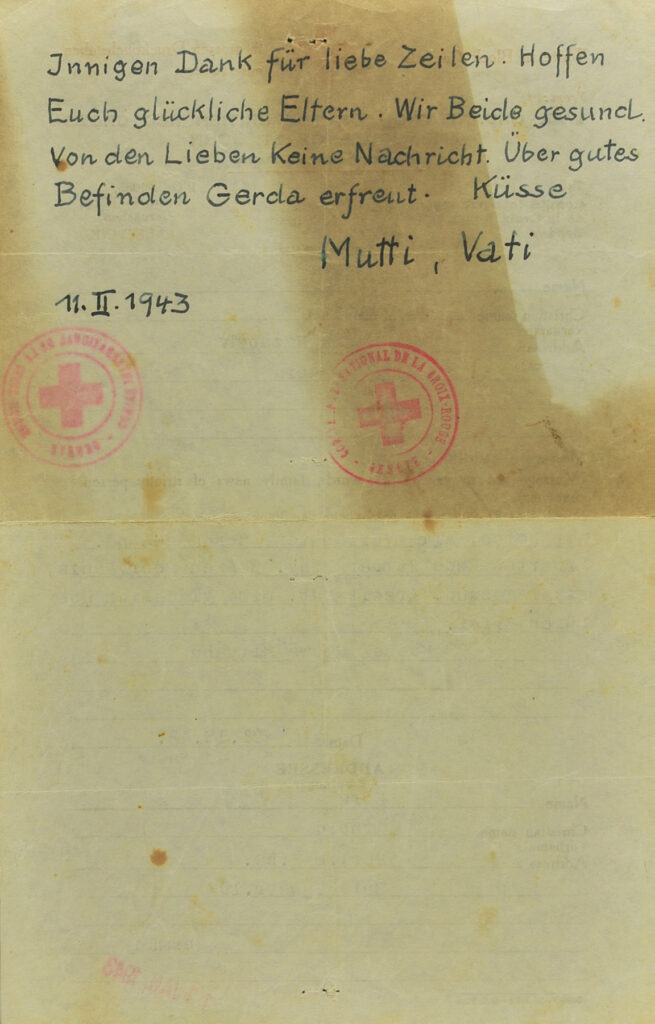
The apparent frustrations that come about from these restricting requirements can be observed. Yet they still serve their purpose in updating individuals on their family’s well being. They still provide connections that would have been alternatively cut off. The Eric Federmann telegram tells his brother, Paul, everything he needs to know. It tells him that he and his wife are well enough to write and it tells him they have money, courtesy of the “Alice and I are well, working.” In 1943, Erna and Arnold Korn(a married couple) wrote in a telegram to their son Walter-Eliyahu, “Sincere thanks for your words. Hope you are happy parents. We are both fine. No news of our dearest ones. [Happy that Gerda is well]. Kisses. / Mother, Father,” (Last Letters from the Holocaust: 1943). Again, this is the entire message. One can infer that these parents, who have not been able to see their son for years, who know very well that this may be the last he hears of them, wish so very much to say a thousand words. But alas, they’re not allowed. Though it’s heartbreaking, again, what’s the alternative? Nothing. Since before the start of the war, Walter-Eliyahu had been living in Israel while his parents were stuck in Berlin. For the years leading up to the war, Walter-Eliyahu and his parents sent letters back and forth weekly. However, once the outbreak of the war hit, Walter stopped regularly receiving posts. Instead, he began receiving telegrams delivered through the International Red Cross. Letters addressed to enemy territory were not allowed out of Germany, Israel and New York City included. Without these restricted messages, they would not have been able to keep contact. The Korn and Becker families’ options were 25 words or nothing.
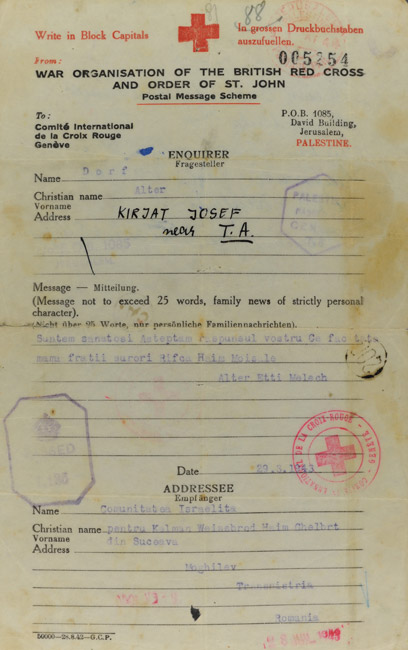
On top of connection, these telegrams provided sources of hope, especially for those taken to Nazi concentration camps. The Ghelbert family, up until the war, lived in a Northern Romanian village. They unfortunately, in 1941, were deported and forced to the Katsmazov concentration camp. After nearly two full years, they received a Red Cross telegram from an extended family member living in Israel. A Yad Vashem page, in regards to this message, states, “The telegram was a source of great happiness among the inmates in the camp since this was their first and almost only connection with the outside world; it signified that their existence was known to people in the free world,” (“We are Healthy in the Katsmazov Ghetto”). The Ghelbert family addressed telegram reads, “We are healthy. Awaiting your reply. How are father, mother, our brother, our sister, Rifca, Haim, Moisale? / Alter, Etti, Melech,” (“We are Healthy in the Katsmazov Ghetto”). These words, though simple and brief, sparked hope among the camp prisoners. Logically speaking, that message is meaningless. To them, however, it meant everything.
It is saddening how little words could be sent, even more so considering the gaping period of time these families had to wait for each message. Yet, what’s most saddening is the Nazi jurisdiction of complete cutoff from loved ones living in outside territories. This Red Cross connection, despite the heavy restrictions, was necessary for these Jewish families and individuals. It is thanks to these messages that Jewish families within German territory could keep contact with their emigrated family members. It is thanks to these messages that camp prisoners could feel even the littlest amount of joy.
References
Treaties, States parties, and Commentaries. Geneva Convention on Prisoners of War, 1929. https://ihl-databases.icrc.org/ihl/INTRO/305
Treaties, States parties, and Commentaries. Geneva Convention on Prisoners of War, 1929 – PART VI : BUREAUX OF RELIEF AND INFORMATION CONCERNING PRISONERS OF WAR – ART. 79. https://ihldatabases.icrc.org/applic/ihl/ihl.nsf/Article.xspaction=openDocument&documentId=A1DAA9CE7432A838C12563CD00519260
(2017) History.com. Geneva Convention. https://www.history.com/topics/world-war-ii/geneva-convention#section_3
Letters: 1938-1946. JFCS Holocaust Center of SF. https://holocaustcenter.jfcs.org/library-archives/exhibits/letters-1938-1946/
Last Letters from the Holocaust: 1941. Yad Vashem. https://www.yadvashem.org/yv/en/exhibitions/last-letters/1941/index.asp#/overview
Last Letters from the Holocaust: 1943. Yad Vashem. https://www.yadvashem.org/yv/en/exhibitions/last-letters/1943/korn.asp
Yad Vashem Documents Archive. Yad Vashem Documents Archive. https://documents.yadvashem.org/index.html?language=en&search=advance&re_value=O.75&re_type=literal&mt_value=Red%20Cross%20letter&mt_type=exact
(2015). The Red Cross and World War Two. History Learning Site. https://www.historylearningsite.co.uk/world-war-two/the-red-cross-and-world-war-two/#:~:text=These%20’letters’%20were%20restricted%20to,million%20messages%20had%20been%20exchanged.
JFCS Holocaust Center – Northern California’s Primary Resource. JFCS Holocaust Center of SF. https://holocaustcenter.jfcs.org/app/uploads/2015/06/letters-catalogue.pdf
Red Cross Letters: Proof of Life in 25 Words or Less. Jewish Museum Berlin. https://www.jmberlin.de/en/red-cross-letters-proof-life-25-words-or-less
Letters Home. HI Stories. https://histories.hoover.org/letters-home/
Red Cross Letter. German Jewish Family Archives. http://www.sussex.ac.uk/affiliates/gjfa/collections/1939-1945-world-war-ii/red-cross-letter/
Red Cross Letter: Instructions for Reply. German Jewish Family Archives. http://www.sussex.ac.uk/affiliates/gjfa/red-cross-letter-instructions-for-reply/
Letter from Eric Federmann to Paul (1944). German Jewish Family Archives. http://www.sussex.ac.uk/affiliates/gjfa/red-cross-letter-from-eric-to-paul/
Notes on Communicating with Occupied Territory. German Jewish Family Archives. http://www.sussex.ac.uk/affiliates/gjfa/notes-on-communicating-with-occupied-territory/
“We are Healthy in the Katsmazov Ghetto.” Yad Vashem. The World Holocaust Remembrance Center. https://www.yadvashem.org/gathering-fragments/stories/correspondence/ghetto-katzmazov.html
Weekly Writing #5
Love Letters
Reading many of the My Dear Bessie letters was a very engaging activity this past week. To my surprise, as well, it was quite a thought provoking one. For the most part, I found Chris Barker and Bessie Moore’s conversational letter writing styles to be entertaining and sweet. I loved how thorough their responses were, addressing every detail the other mentioned in their letter. Chris’ letters, as well, were especially beautiful. His were almost poetic. One of my favorite lines from him reads, “[My love for you] is a fever that I have. It is irrational, nonsensical.” Comparing his love to a fever was striking. It even left me smiling slightly. Reading the letters, though entertaining, made me feel guilty almost. They begin to write very explicitly about the other and I couldn’t help but feel I was intruding. These were very personal letters, so I felt strange being allowed to read through and analyze them. It made me wonder, do archivists(or anyone who’s profession involves letter analyzing) ever feel guilty about reading through real people’s private letters? After reading My Dear Bessie letters, I began to really understand Martha Washington’s motivation for burning her letters from George Washington, wanting to keep their relationship private.
Weekly Writing #4
As I watched everyone’s WWII presentations, it was really interesting to see how similar each of the soldiers covered were. Not only being Muhlenberg alumni, but each soldier was also described to be very involved Muhlenberg students, to be positive spirits, and to have enjoyed their military training(despite the rigorous level). Additionally, I really enjoyed seeing how invested everyone was in sharing their topics. While presenting, every one of my classmates seemed very fascinated and excited to teach us about their chosen soldier.
Weekly Writing #3
This week, our lessons were centered around US Japanese internment during World War II. I had remembered learning about the subject in middle school, but this week showed me how little I was being taught. Reading through the Miss Breed letters, especially, put the situation into perspective. It hurt, learning what these children were going through. Their letters brought about another, deeper layer to the lesson. Rather than just learning what was happening to them, we got to feel what they were experiencing.
